Technology Updates

Wednesday, October 1, 2008

Microsoft Releases Windows CE 5.0 Beta

While Microsoft has strong developer and partner networks, Gartner research vice president Martin Reynolds told TechNewsWorld that it is unlikely any company will dominate the embedded market because it is so fragmented.

Promising a more integrated and economical development environment, Microsoft (Nasdaq: MSFT) Latest News about Microsoft has released a beta of its newest embedded operating system (OS), Windows CE 5.0, at the Embedded Systems Conference in San Francisco.

The company touted cost savings that can be achieved using the new OS, thanks to the blending of command-line and graphical integrated development environments (IDE). Microsoft also pointed to increased support World Class Managed Hosting from PEER 1, Just $299. Click here. for drivers, chipsets and its DirectX desktop programming model, aimed at providing richer graphics and multimedia features that are closer to the desktop experience.

The software giant faces a much different situation in the market for embedded systems -- smaller, lighter operating systems used in set-top boxes, mobile devices and other machines that are simpler than PCs -- compared with its dominant position in the desktop operating-system sector.

"Within CE, Microsoft has not been number one," Yankee Group senior analyst Laura DiDio told TechNewsWorld. "So, in that situation, they're going to work harder to stay in the game, improve the software and play catch-up. That's what this is about."

Unified Development

Microsoft, which distributed preview copies of the new Windows CE 5.0 at this week's embedded conference, said the final release of the software should become available this summer. The preview also will be available for download through the company's developer network beginning April 1st, Microsoft said.

The company is hoping that by enabling developers to use the command line inside the graphical IDE, as opposed to switching between the two development environments, Windows CE 5.0 will save companies time and money.

"Unifying the tools capabilities is a brilliant move for Windows CE," said Doug Boling of embedded consultancy Boling Consulting. "Being able to work in one unified development environment where you only need to use that one toolset for building, debugging and deploying an operating system image will save OEMs a lot of time by reducing complex development issues."

Microsoft also said the new Windows CE 5.0 will feature increased hardware support out of the box, higher security settings, advanced multimedia capabilities and automated testing tools.

Big Windows, Little Windows

For his part, Gartner (NYSE: IT) Latest News about Gartner research vice president Martin Reynolds said Microsoft is trying to tie its desktop operating systems, such as Windows XP, closer to the embedded OS so that making something for CE also has value in XP.

"They're getting their development environment aligned on big Windows and little Windows," Reynolds told TechNewsWorld.

The analyst, who referred to the need for less-cumbersome operating systems in embedded devices, said the Windows CE 5.0 release is part of a larger goal to create a common feel in all Windows development, "from pager to desktop."

Tech Focus with Gates

The Yankee Group's DiDio credited the CE 5.0 effort in part to the more prominent role Microsoft head Bill Gates has taken since serving as chief scientist for the company.

"I can't tell you how much he's focusing on technology rather than business," DiDio said. "They've done a very credible job at really making their products work better."

She added that as developers seek to work with computing environments that will be profitable, they likely will be excited about the new Windows CE. However, DiDio also referred to gains by Linux, which is an attractive opportunity in the embedded space as well.

"Linux looks like green fields," she said. "It's getting better, and developers are going for that, too. Right now, you'd have to be a fool to ignore the Linux market."

Fragmented Market

Reynolds referred to a large field of competitors in the embedded operating-system market, with Symbian taking hold on mobile phones, Palm succeeding in handhelds and other consumer devices, and Linux, which is most prominent in the TiVO digital video recorder, also being backed by a Japanese consortium.

Indicating that the biggest challenge for all embedded players is price because of low profit margins in this space, Reynolds said the price issue has hampered Microsoft's embedded efforts. And while Microsoft does have strong developer and partner networks, he added that it is unlikely any company will dominate the embedded market because it is so fragmented

Tuesday, September 30, 2008

Microsoft updates Live Hotmail and Maps

On Monday, Microsoft updated two of its Live services: Windows Live Hotmail and Live Maps. Of the two, the changes to Hotmail are not yet available to everyone. The company began rolling it out to some of its users this weekend, with everyone else getting their hands on it in the next few weeks. It's the newer, faster version of the service that brings in gains of up to 70 percent compared with older versions of Hotmail. (Read more about that here.)

Meanwhile, Live Search Maps, Microsoft's online mapping tool has a really neat new way to get directions using local landmarks and local businesses. If the service picks up on one of these landmarks as part of your route, it will use it in addition to the street name. Oftentimes this comes in handy where a business has better signage than the city, which in the case of car dealerships and fast food restaurants is almost always true.

Click to enlarge

(Credit: CNET Networks)

Chris Pendleton, Microsoft Virtual Earth's Tech Evangelist, says these landmarks are currently limited to these six categories:

  • Gas Stations
  • Major National Chains of Hotels
  • Restaurants
  • Convenience Stores
  • Grocery Stores
  • Car Dealerships

To help get you there, there's a new multistop trip planner--a feature Google Maps has had since late 2006. This means you can add other addresses between the point A and point B of your trip, then print it out to stick in your car.

The service is also now instantly indexing community maps. Maps that users have created will now be able to be searched by everyone immediately. The user-created items will also be mixed in with business results, which means you or someone else could enter in a business' address and phone number before it's been officially added and have it show up in regular searches. Neat.

IBM releasing iNotes for iPhone


IBM has released a way to get Lotus Notes e-mail on your iPhone that stops short of full support, but gets the job done.

IBM's iNotes Ultralite (no trademark fight necessary) will be formally released Tuesday for Notes administrators and iPhone users. The software is a Web application that allows you to access Notes mail through the Safari mobile browser on the iPhone. Administrators need to install IBM Lotus Domino Web Access 8.0.2 in order to make the whole thing work.

One of the more popular additions to the iPhone 3G was the support for Microsoft's Exchange technology, which allows you to get your corporate Exchange e-mail on the iPhone's Mail client. IBM and Apple haven't inked a deal to do the same thing for Notes as of yet, but an IBM representative said the two companies are working to bring the Lotus Notes Traveler software to the iPhone.

iNotes Ultralite is a free download from IBM

WAN Optimization

Organizations are realizing that increasing bandwidth capacity is not necessarily the most effective solution for dealing with issues with application performance over the wide area network, write Aberdeen's Bojan Simic and Andrew Stamer. Companies are looking to significantly increase their spending on WAN optimization and application delivery solutions over the next 12 months.

The importance of creating synergies between the deliverance of business-critical data over the wide area network (WAN) to support World Class Managed Hosting from PEER 1, Just $299. Click here. remote employees is increasingly important to business because more than half of the total workforce works outside the corporate headquarters' structure.

According to Aberdeen's February 2008 Benchmark report, "The Roadmap to the Next generation Branch Office Networks," the number of end-user organizations expect the number to increase by 7 percent by the end of 2008.

These increases in remote employees, coupled with the fact that a survey of over 170 organizations between July and August 2008 revealed that 62 percent of the servers and 65 percent of enterprise applications have been centralized, shows the need to optimize these network systems. Aberdeen's research has also found that the need to centralize and consolidate data storage stems from an organization's average savings of 11 percent in operational costs.


Ballooning Bandwidth

As shown, corporate data is becoming increasingly centralized, and workforces are becoming increasingly remote, which is causing organizations to find a cost effective way to seamlessly deliver corporate data to their remote employees. Because of this duality, organizations are expecting bandwidth capacity to increase by an average of 108 percent over the next 12 months.

This increase is a must because, as one network architect from a financial services company put it, "Once you combine voice, video and data on the same network, the bandwidth consumption will explode. You need to have the right set of tools in place to ensure that your network will be able to handle that."

Organizations are increasingly concerned about delivering rich content (video, Web 2.0, Java Latest News about Java, etc.) to their remote employees, as these applications could drive significant increases in bandwidth consumption and cause issues with application protocols.

In order to distinguish the path of least resistance toward WAN optimization, Aberdeen used criteria to distinguish between Best-in-Class and all others with three key performance indicators: Average improvement in bandwidth use, average improvements in application response times, and average decreases in WAN latency.

Best-in-Class organizations, on average, showed a 79 percent improvement in bandwidth utilization, improved average response times for business critical applications by 12.5 times, and had a 38 percent decrease in WAN latency.

Most companies that fell into the Best-in-Class category shared several common characteristics. They were three times more likely to have formal communication channels between application development and systems and network management teams when compared to Laggards. They were also nearly three times more likely to have the ability to identify application performance bottlenecks when compared to counterparts in the lower 30 percent. They were nearly six times more likely to have the ability to conduct a cost-benefit analysis of bandwidth upgrades.

The Impact of WAN Optimization Initiatives

Aberdeen's June 2008 Benchmark Report, "Application Performance Management: The Lifecycle Approach Brings IT and Business Together," reveals that 72 percent of network-related issues with application performance involve delivering corporate data over the WAN. Additionally, Aberdeen's Benchmark Report from October of 2007, "Optimizing WAN for Application Acceleration," revealed that 47 percent of organizations that conducted bandwidth updates of their WANs experienced no improvements in application performance.

Organizations are realizing that increasing bandwidth capacity is not necessarily the most effective solution for dealing with issues with application performance over the WAN, and they are looking to significantly increase their spending on WAN optimization and application delivery solutions over the next 12 months.

Aberdeen's research shows that the top pressures driving the adoption of WAN optimization and application delivery solutions are the following:

  • Centralization of business-critical data and applications (59 percent of all survey respondents)
  • The need to optimize employee productivity (37 percent)
  • The need to decrease cost of data communications (30 percent)

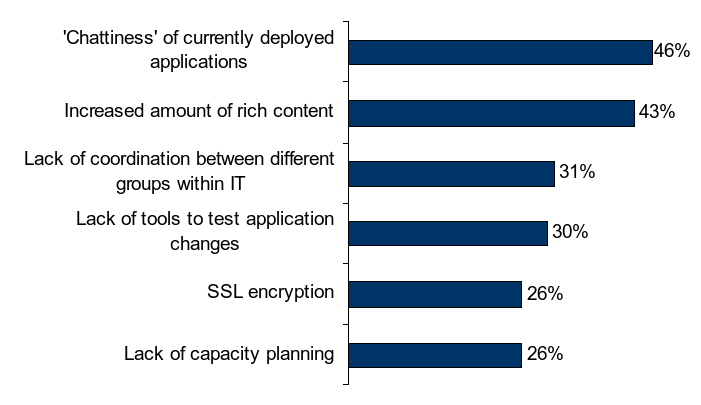
Figure 1 shows that interdependencies between applications on the network and applications, and the network itself, are the top obstacles for delivering corporate data over the WAN.

CLOSE X
Loading Image...

(click on image to enlarge)

The Importance of Building a Business Case

Aberdeen's June 2008 Benchmark Report, "Application Performance: The Lifecycle Approach Brings IT and Business Together," found that issues with application performance could impact overall revenues by up to 9 percent.

While organizations could experience significant business benefits from infrastructure projects such as data center consolidation, server virtualization and VoIP (voice over Internet protocol) deployments, it should be noted these initiatives could pose some additional challenges for delivering corporate data to remote users because of the inability to create a business case, as revealed in Aberdeen's February 2008 Benchmark Report, The Roadmap to the Next Generation Branch Office Networks. In order to create a business case for WAN optimization initiatives, organizations need to assess the impact of performance issues on their business processes.

"With respect to network performance and troubleshooting, I would recommend the selection of one of the tools that provides visibility of traffic by protocol and by well known application," said a network manager for a professional services company as part of the Aberdeen survey. "The best tool is one that will graphically indicate transaction times divided into network time, platform (server) time, and application time. If such a tool is adopted by the support teams responsible for these different areas, incident and problem related downtime can be reduced. Such tools are, of course, expensive. A business case needs to be built."

Virtualization Projects Increasingly Impact Application Performance

Organizations are becoming increasingly concerned about the impact that VoIP deployments, virtualization, data center consolidation and business continuity and disaster recovery initiatives are having on performance of their WAN. As compared to what was reported in 2007, organizations are still seeing VoIP deployments as the top concern in ensuring optimal performance of other business-critical applications over the WAN. With VoIP being bandwidth-intensive and time-sensitive technology, these deployments are causing additional challenges with prioritizing network traffic and effectively assigning classes-of-service to other applications that are running on the network.

Additionally, Aberdeen's research shows a 75 percent increase in number of organizations that are concerned about the impact of server and desktop virtualization projects on the performance of their business-critical applications. This increase that occurred over the period of 11 months also shows that some of the WAN optimization and application delivery solutions that organizations are currently using are not effectively addressing this issue, and organizations are looking to deploy solutions that would include features and functionalities that would be specific to optimizing application performance while conducting virtualization projects.

Aberdeen's June 2008 Benchmark Report, "Application Performance Management, The Lifecycle Approach Brings IT and Business Together," found that organizations could lose up to US$117 million due to issues with application performance. The report also revealed that 72 percent of network-related issues involve delivering corporate data over the WAN.

Quantifying Application Performance Issues on Business Goals

Organizations are realizing that issues with application performance have a strong impact on key business processes, but the majority of organizations find it difficult to quantify that impact and include in their ROI calculations when making purchasing decisions about solutions for optimizing application delivery over the WAN.

The good news is that more than a half of end-users in Aberdeen's survey reported they are taking actions to evaluate the impact of application performance issues on business goals. In order to effectively complete that task, organizations needs to develop a set of capabilities to maximize utilization of their network and business resources.


(click on image to enlarge)
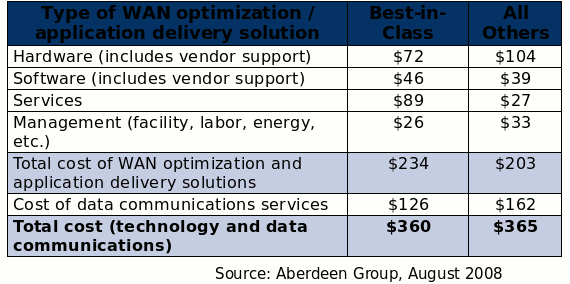
As shown in Table 1, Best-in-Class organizations are more likely to invest in solutions for WAN optimization and application delivery, while Industry Average and Laggard organizations are investing more in increasing bandwidth capacity. Additionally, Best-in-Class organizations are more likely to be investing in services for WAN optimization and application delivery, whereas 84 percent of technology investments for all other organizations are being directed to hardware and software purchases.

Best-in-Class organizations were able to improve application response times by more than 11 times as compared to 13 percent average improvement for Laggard organizations. The ability to conduct a cost-benefit analysis of bandwidth upgrades allowed Best-in-Class organizations to select the right approach when optimizing application performance over the WAN.

As a result, these organizations were able to outperform their peers around achieving their common goals while spending slightly less on WAN optimization and application delivery solutions and bandwidth services.

Dev Pros to Get Rough Cut of Windows 7

Contrary to rumor, Microsoft will indeed give developers the alpha version of Windows 7 at next month's developers conference, the company confirmed. Microsoft usually slips devs primitive copies of in-the-works operating systems to give them a heads-up on what to expect, what to work on, and how to take advantage of new features.

Developers attending Microsoft's (Nasdaq: MSFT) Latest News about Microsoft Professional Developers Conference, set for Oct. 27 through 30 in Los Angeles, will leave with an alpha version of the software maker's upcoming Windows 7 operating system (OS), the company confirmed Wednesday.

Microsoft has historically offered up early versions of upcoming OSes to developers. However, this recent promise dispels rumors that Redmond was planning to skip its traditional alpha release due to timing issues in developing Windows 7.

"This is common. It would have been a bigger deal if they had not given the people attending PDC the code," said Michael Cherry, lead analyst at Directions on Microsoft.

The rumor, Cherry told TechNewsWorld, stated "that [Microsoft] was not going to release it. Had they not, it would be taken as a sign that they were behind on their development plans. [Microsoft] can't win. If they give people code at PDC, then everyone will evaluate it and start to comment on what they think Windows 7 will be. If they don't give code, everyone will assume they cannot get it shipped. So they're in a no-win situation. In this front, it is hard to be Microsoft."

Discovery Zone

Developers heading to PDC next month now know they will be able to take a rough version of the next Windows OS for a test drive. However, Microsoft has divulged few details about what it plans to show off to developers, save that they will "see advances across the full range of Windows -- including the kernel, networking, hardware and devices, and user interface."

However, once they have the pre-beta code in hand, developers will have a wealth of information they will use to decide whether and how to optimize their software to function with Windows 7.

"Developers are just eager to see what things Microsoft is changing, but will wait for a more stable build before they begin their work. Others will be looking to see what this means in terms of what they can do with their applications -- and whether to try and exploit Windows 7 with their applications," Cherry explained.

Specifically, developers expect performance World Class Managed Hosting from PEER 1, Just $299. Click here. improvements to the .NET framework and more Windows Presentation Foundation (WPF) controls, said Jeffrey Hammond, a Forrester Research analyst.

"I think support for new interaction model interests developers, and then specifically for ISV developers, there's interest in being able to continue to take full advantage of frameworks like DirectX," he told TechNewsWorld.

With the Windows 7 alpha code released, Microsoft hopes to receive feedback from developers on the OS.

"The more feedback they can get early in the process, the better. By the time you get to formal beta, it's often pretty hard for software development shops to make real substantive changes -- the feedback period becomes more about fixing defects and taking input for the next release planning cycle," Hammond pointed out.

Something to Work With

Software developers are not looking for Microsoft to make a host of changes with Windows 7 but are interested in what their programs can take advantage of. Given Vista's well-reported compatibility issues, they will definitely be looking to see that Microsoft has remedied the problem in Windows 7, Cherry said.

"Developers are looking to have their applications run wherever there are the most places for them to run. So right now, if your application runs on Windows XP and probably runs OK on Vista, you're probably covering the largest set of places where an application can run," Cherry noted.

What developers want is for Vista, and then Windows 7, to really take off -- and pull their applications, designed to take advantage of the operating system's features, with it, Cherry said. They want to know whether it will be worth it to optimize their applications to work with a particular version of an operating system.

Many developers need a larger installed base to sell their software to than currently exists with Vista. Meanwhile, with Windows 7, Microsoft needs to get developers to write software that takes advantage of new features to make the new OS attractive to upgraders, Michael Silver, a Gartner (NYSE: IT) Latest News about Gartner analyst, told TechNewsWorld.

For instance, many developers are increasingly making investments in rich Internet applications (RIAs). That makes the choice of desktop less important than choice of browser, noted Hammond.

Nokia to buy Oz Communications


Nokia is bulking up its communications platform with the acquisition of Oz Communications, a privately held Montreal-based company that offers mobile e-mail and instant messaging.

On Tuesday, Nokia said it would buy Oz for an undisclosed amount, bringing Oz into its services and software unit. The deal is expected to close in the fourth quarter.

Oz has been around for about five years. And the company, which has been working with Nokia since 2003, has raised more than $71 million. Its IM, e-mail, and social-networking technologies are used by several mobile operators, including Verizon Wireless, Sprint Nextel, T-Mobile USA, Alltel, and Rogers Wireless. With just 220 employees, Oz claims to have 5.5 million monthly paid users using its products.

The acquisition should fit nicely with other mobile social media and communication buys Nokia has made over the past couple of years, including those of Twango, Plazes, Enpocket, and Navteq.

With these acquisitions, Nokia has been amassing a portfolio that extends far beyond handsets. It is looking to extend its reach to services and applications, integrating devices with services and packing them with cool features such as navigation, mapping, and music. The idea is that the services will help differentiate the handsets from others on the market and also provide the company with additional revenue.

Nokia is still in the early days of executing on this strategy. It just officially launched its Ovi platform, which serves as a hub for many of its services. So it's difficult to say how successful it will be. The company leads the market, in terms of handset sales worldwide. But it's had a weak standing in the United States, where some of these more advanced services would likely play well.

Meanwhile, Nokia is facing competition from new entrants in the mobile market, such as Apple, with the iPhone, and Google, with the new Android operating system. These companies are also emphasizing services and applications as way to differentiate their products.

Apple launched the App Store earlier this year, when it released the new iPhone 3G. And the first Google Android phone will go on sale next month on T-Mobile USA's network. Like Apple's App store, Android also has a marketplace in which third-party developers can distribute applications for Android phones.

Microsoft taps Yusuf Mehdi for MSN post

Yusuf Mehdi

Microsoft named Yusuf Mehdi to run marketing for its online MSN and search properties, the company said Monday. His team runs marketing, product management, strategic partnerships, and business development for the sites.

Mehdi reports to Chief Executive Steve Ballmer until a new executive is named to run Microsoft's overall online services group, the company said. Jon Tinter of the MSN group and Brad Goldberg of the search group report to Mehdi.

Bill Veghte previously ran the MSN and search marketing work, but his title now is senior vice president for the Windows business. Brian Hall and his Windows Live teams still report to Veghte, Microsoft said.